What happens
From the first phone call to the last coat
Nine steps. The one that matters most is the last one, because it is the one this whole industry gets wrong.
The nine steps of a job
You call, or fill in the form
A person calls you back within one business day. We ask what you are trying to fix, when you need it, and whether the house predates 1978.
The walk-through
An estimator comes out, measures, photographs every failure point and probes anything suspicious. Usually 45 minutes. You get the photos.
The written estimate
One fixed price. Product line and sheen named. Number of coats named. Prep itemised. Exclusions listed. Start and substantial completion dates, because Massachusetts law requires them. It holds for 30 days.
You compare it
We would genuinely rather you got three bids. Our estimate is written so it can be compared line by line — that is the point of writing it that way.
Contract and deposit
No more than one third up front, which is the maximum Massachusetts allows. Your HIC registration number, 177081, is on page one.
Colors
Samples brushed onto your actual walls or siding, looked at in morning and evening light. If you are in a historic district we tell you what approval you need before you order anything.
Set-up day
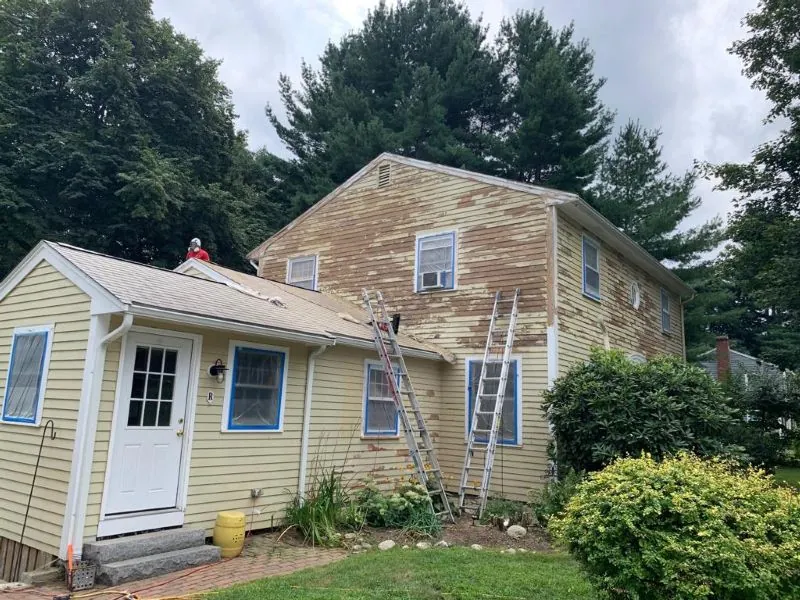
Protection goes down before anything else happens. Plants pre-wet and covered, floors papered and taped, furniture centred and sheeted, outlets bagged. You meet your project manager and get a direct number.
The work
Daily set-up and take-down so you get your house back each evening. Daily progress note from your project manager. Any discovery — rot, hidden damage — stops work and produces a written change order with a price before we continue.
The Final Walk
We walk the property together. You point at anything, however small. It goes on a written punch list. We complete every item. Then we invoice the balance — never before.
Why the last step is the whole point
One complaint homeowners report about painting projects is a job that gets to 95% and then goes quiet. The punch list never gets finished, the phone calls slow down, and the customer ends up chasing.
So we made the last 5% a scheduled, named, signed event with money attached to it. It is not goodwill; it is the payment term.
Property protection, written down
- Plantings pre-wet, covered with breathable cloths, rinsed at end of day
- Nothing — doors, shutters, ladders, materials — stored on lawns
- Floors papered or canvassed and taped at the edges
- Furniture centred and sheeted; outlets and plates removed and bagged with their screws
- Zip walls and HEPA extraction when sanding
- Daily debris removal; chips collected, not swept into beds
- End-of-day walk by the project manager before anyone leaves
FAQ
How the job runs — questions
What if I am not happy with something at the end?
That is exactly what the Final Walk exists for. You write it on the list, we fix it, and only then do we invoice the balance. If something surfaces after that, the written warranty covers workmanship for three years.
Do you work when we are away?
Yes, and plenty of customers prefer it. We agree access, we photograph progress daily and send it to you, and we do the walk-through when you are back.
What time do you start?
Whatever time we agree with you. The default is 8am, but if you have a baby napping or work calls until nine, say so and we schedule around it.
Will the same crew be here every day?
That is the goal and it is what we schedule for. If a crew has to change mid-job because of weather or an emergency, your project manager tells you before it happens rather than after.
Get a real number, in writing, within one business day.
Walk-through, measurements, a fixed price and a start date. No pressure, no “today only” discount, no obligation.